
Hidden companion likely behind 113-day outbursts of massive star in galaxy NGC 4559
A new study points to a black hole or neutron star pulling material from the star AT 2016blu, about 30 million light-years away. NASA's Chandra X-ray Observatory supplied the key observations.

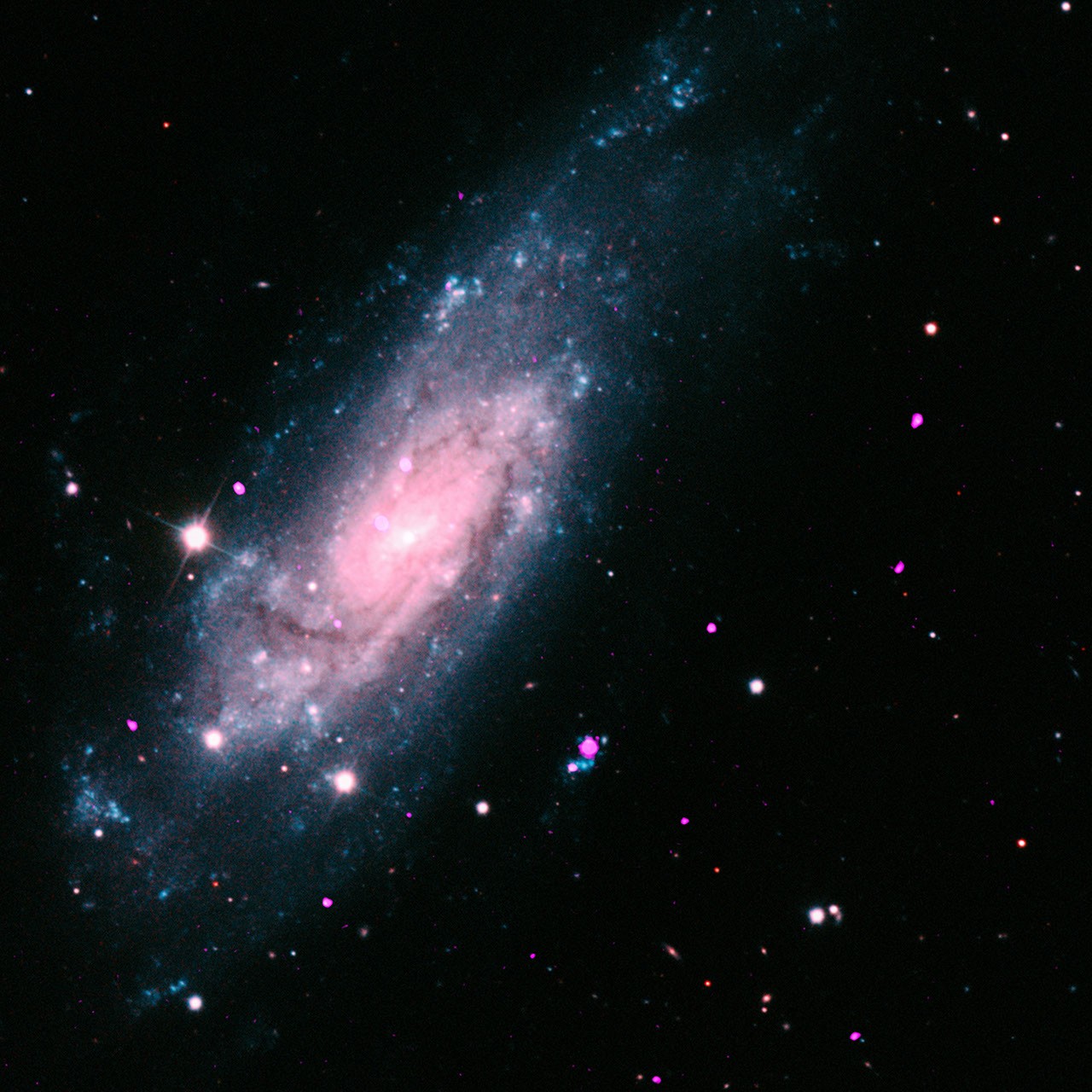
For 15 years, a massive star in a distant spiral galaxy has brightened and faded on a rhythm astronomers could not explain. A new study suggests the cause is something no telescope can see directly: a dense companion, either a stellar-mass black hole or a neutron star, pulling material away from the star every 113 days as the two orbit each other.
The study, in The Astrophysical Journal, centres on AT 2016blu, a star in NGC 4559, a spiral galaxy about 30 million light-years from Earth. Astronomers estimate its mass at no less than 33 times that of the Sun. NASA says it is the first X-ray detection of one of this class of erupting stars.
The result leans on a wide network of observers, including more than 30 amateur astronomers whose observations came through the American Association of Variable Star Observers. That is a useful reminder for anyone in Metro Vancouver who watches the sky as a hobby: patient, regular observation still feeds into professional research.
AT 2016blu is a luminous blue variable, a hot, massive star defined by changes in brightness. Its eruptions can resemble a supernova, but the star is not destroyed, which is why such objects are also called "supernova impostors." Between 2012 and 2026, astronomers detected at least 27 optical bursts, roughly 113 days apart. Optical monitoring used the Katzman Automatic Imaging Telescope and the Las Cumbres Observatory Global Supernova Project.
Study lead Mojgan Aghakhanloo of the University of Virginia said astronomers had watched the star brighten and dim regularly for 15 years. Co-author Núria Torres-Albà, also of the University of Virginia, said the team realized X-ray data were needed to understand what was driving the eruptions.
That is where Chandra came in. According to NASA's release, it is the only X-ray telescope sharp enough to distinguish AT 2016blu from another bright X-ray source nearby. When the star was seen in outburst in early 2026, Chandra observations were triggered and obtained in March 2026. They showed the star at least 100 times brighter in X-rays than in Chandra data from 2001 to 2002, before the outbursts began. It is bright enough to be classified as a candidate ultra-luminous X-ray source.
The best explanation, the researchers say, is that the star and its companion follow an oval-shaped orbit. At closest approach, material from the star falls onto the neutron star or black hole. A neutron star is the dense collapsed core of a massive star. Co-author Nathan Smith of the University of Arizona said dense gas around the system is heated by X-rays and then glows in the optical.
NASA also says the observations suggest there could be a link between ultra-luminous X-ray sources and violent stellar eruptions. NASA's Marshall Space Flight Center in Huntsville, Alabama, manages the Chandra program, and the agency released an image of the galaxy on Nov. 9, 2026. More on the mission is at NASA's Chandra page.
Sources
Facts first. Context second. Sources always. This story was prepared with AI assistance from the sources listed above and reviewed by a Northline editor before publication. How we use AI · Report an error