
Star swallowed a companion in Andromeda in about seven years, Webb data show
A star slightly lighter than the Sun spiralled into a puffy supergiant at the edge of the Andromeda galaxy. Astronomers used the James Webb Space Telescope for the earliest follow-up yet of such a merger.

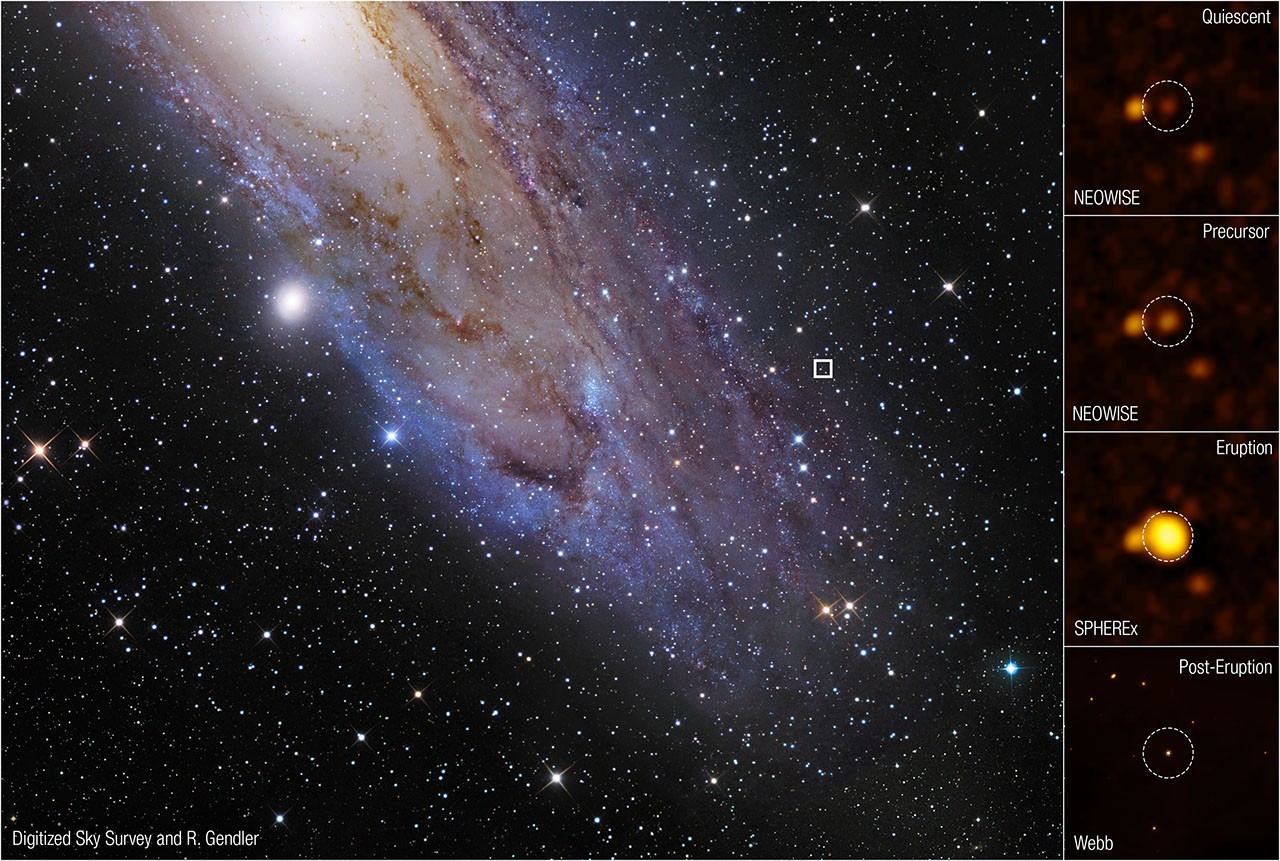
A star slightly less massive than our Sun spiralled into a far larger supergiant on the outskirts of the neighbouring Andromeda galaxy, and the two merged after only about seven years of close contact. Astronomers caught the eruption and followed it with the James Webb Space Telescope.
The findings appear in a new paper in Nature, whose first author is Viraj Karambelkar of Columbia University. The binary system, and the star it became, are nicknamed Bao. The object is formally known as AT 2025abao. For Vancouver readers there is a Canadian link: Webb is an international observatory in which the Canadian Space Agency is a partner alongside NASA and the European Space Agency.
Stellar mergers are hard to observe in real time because they are hard to predict. This team managed to observe the system before, during and after the event, then used simulations led by Karel Temmink, a PhD student at Radboud University, to reconstruct what happened. Webb's observations were taken on Dec. 24, 2025, under a Director's Discretionary Time program. That was 47 days after the eruption peaked, which the researchers describe as the earliest follow-up ever made of such an event.
Before the eruption, the larger star, called Big Bao, was seven times as massive as the Sun, 350 times its radius and 18,000 times brighter. Its companion, "Little Bao," was estimated at about 0.7 solar masses, with a slightly smaller radius than the Sun and less brightness. Further analysis determined that Little Bao was dragged into the core of Big Bao.
The speed is what stands out. After contact, the merger took just seven orbits, about seven years. Other known mergers of binary stars, which involved two smaller stars, took thousands of orbits. Webb's mid-infrared observations also detailed dust that the primary star had shed over centuries.
The trail of observations stretches back more than two years. The team first noticed the variable star in NEOWISE data in February 2023. WINTER observations in September 2024 showed it beginning to brighten. During a routine survey in July 2025, SPHEREx saw it fade rapidly in visible light while brightening in the infrared. The Zwicky Transient Facility detected the eruption itself on Oct. 17, 2025.
Co-author Nadia Blagorodnova, an associate professor at the University of Barcelona, described how abrupt the flare was: the brightness started rising and peaked within a week. Kishalay De, an assistant professor at Columbia University, is also a co-author. The work is funded in part by a NASA grant.
What the merged star looks like now will only be known through future observations. Looking further ahead, the Roman telescope's Galactic Bulge Time-Domain Survey is expected to yield many new transient events that could benefit from similar analysis.
Sources
Facts first. Context second. Sources always. This story was prepared with AI assistance from the sources listed above and reviewed by a Northline editor before publication. How we use AI · Report an error